The translation isn't perfect, but Aristotle's main point in a
quote to which he's attributed is that poetry is often truer than
history, for it captures the universal experience, while history is
relegated to a particular time and place.
This is the theme “Boardwalk Empire” has flirted with since it
debuted on HBO six years ago. A series that consistently dealt you
style in addition to (and sometimes, I would argue in lieu of)
substance, Terrence Winter's love song to the era that birthed
organized crime in the United States consistently took license with
the historical record to bring viewers an intensely personal drama.
Boardwalk struggled to recapture its central conflict after Steve
Buscemi's Nucky Thompson killed his main threat, Jimmy Darmody, at
the end of season 2. We were introduced to Bobby Canavale's brilliant
Gyp Rosetti in season 3, then Jeffrey Wright's verbose and wily
Valentin Narcisse in season 4, who quickly picked a fight with
Michael Kenneth Williams' Chalky White. In the interim, Jack Huston's
Richard Harrow tried and failed to establish a normal life for
himself after putting that rifle in his mouth in season 2, Nelson Van
Alden (Michael Shannon) bumbled his way through a stint in organized
crime in Chicago and attracted the attention of Stephen Graham's Al
Capone, while Gillian Darmody (Gretchen Mol) descended slowly into an
opium-fueled madness that produced some of the series' finest (and
creepiest) performances.
It was, to put it mildly, an oft-unfocused mess. While the
backdrop of violence, sex and power-grabbing (fueled mostly by the
brilliant performances of Vincent Piazza and Anatol Yusef as Charles
“Lucky” Luciano and Meyer Lansky, respectivey) always kept
viewers glued to the screen, the series was billed as Nucky
Thompson's rise and fall from power, a theme that seemed to die along
with Jimmy in that rain-soaked construction pit.
Thankfully, season 5 successfully recaptured that spirit,
introducing us to a younger Nucky as he developed into the
“half-gangster” we say greasin' palms and griftin' so many years
ago. And in the series finale, that story arc came full circle in a
climax that brilliantly thumbed its nose at history and gave us the
poetic end Nucky deserved, rather than the quiet death he received in
real life.
Enoch “Nucky” Johnson, the real life mogul that Nucky Thompson
is based upon, lived to 85, dying of old age in Northfield, New
Jersey, in 1968. Had the writers chosen to give their title
character, who differed from the real Johnson in many ways, such an
end, it would have been an affront to the decision to make him the
source of his own fall from grace. The final moments of the series
finale brilliantly blend the fatal pistol blasts from a young Tommy
Darmody with the offer of Gillian to the commodore, Nucky's act of
desperation for power that spawns all the events of the series. It's
an ending that forms a perfect circle and the closure to Nucky's
quest for power – and its convoluted telling – that only art, not
life, could produce.
Showing posts with label television. Show all posts
Showing posts with label television. Show all posts
Monday, October 27, 2014

Sunday, August 10, 2014
Couch Surfin': The Memorable 'Sopranos' Saga
I was a little late to the party on "The Sopranos." It was always on my list of shows to watch, but for some reason "House," "The Wire" and "How I Met Your Mother" took precedence during my college days of lazily binge-watching online episodes between classes, runs and work.
With the death of James Gandolfini last summer, I figured I owed it to his memory and to my own sensibilities to give the series its due. It took me a year, but I finished the saga this weekend and am in the reflective mood.
The below list may not be the finest episodes of David Chase's classic HBO series, for which we can thank the future airing of shows like "The Wire," "Boardwalk Empire" and "Breaking Bad." Gandolfini and co. showed us we could stomach adult drama on premium television outside the boundaries of traditional broadcast "seasons" and exceeding the content allowed by censors. It may not be the best of that bunch, but it blazed a trail we can duly credit as creating the glut of fantastic TV drama we enjoy today.
SPOILERS BELOW. YOU'VE BEEN WARNED.
"College"
Originally aired: Feb. 7, 1999
"Am I in the what?"
The draw of "The Sopranos," from the beginning, was the centralized character of Tony Soprano, a flawed leader who is trying to juggle the modern demands of fatherhood while reconciling his violent identity as a leader of organized crime. No episode portrays this better than "College," and there's good reason it's cited by many as the best episode of the series. Contrast the above scene, where Tony attempts to rationalize his role to his daughter, Meadow, with the chilling scene where he strangles an old foe. There's a reason "The Sopranos" hit it big early, and "College" was a major part of that.
"House Arrest"
Originally aired: March 26, 2000
"I don't give a shit if you're working with Wal-Mart. Knock it the fuck off."
The downfall of Vito Corleone was his unwillingness to sell hard drugs. There are echoes of "The Godfather," "Goodfellas" and countless other gangster film classics in "The Sopranos." The characters are self-aware that their leading lives glamorized by modern media. The writers co-opted this disdain for hard drugs in Tony's character and his memorable spat with Richie Aprile, setting up the eventual showdown with Uncle Junior that was the basis for much of the dramatic tension in the show's first few seasons. "House Arrest" is also memorable for showing Tony's commitment (and addiction) to the lifestyle. When his lawyer orders him to lay low, Tony's inability to interact with his criminal crew becomes an unbearable burden.
"The Knight in White Satin Armor"
Originally aired: April 2, 2000
"Ballroom dancing is a legitimate art form."
The spat between Richie Aprile and Tony was clearly headed for some kind of resolution, though who would have guessed it would be Janice who put the beef to bed? "The Knight in White Satin Armor" is notable for its exploration of the relationship between Tony and Janice, a complicated tete a tete that lasted for the entirety of the show's run. Gandolfini shows his chops in the scene when he discovers Aprile is dead. There's a look of relief, surprise and - dare I say it - admiration when he sees Richie lying dead in Janice's arms.
"Funhouse"
Originally aired: April 9, 2000
"Why you making me do this, you fat, miserable, piece of fuckin' shit?"
The writers gave us little time to grieve for Richie Aprile before offing Salvatore "Big Pussy" Bonpensiero the next week. Pussy was ratting to the FBI, and when Tony finds out, he orders the hit. Pussy's death becomes a major theme throughout the rest of the show, with Vincent Pastore making multiple guest appearances as Tony's subconscious wrangles with having to "deal with" one of his best friends and top earners. There's a memorable mirror in the final season, as Paulie Walnuts thinks back to Pussy's death and believes Tony's out to off him, too.
"Pine Barrens"
Originally aired: May 6, 2001
"You had Tic-Tacs all along? Give me some!"
Steve Buscemi lent his considerable talents to this episode behind the camera, considered another of the series' best, before appearing as Tony's cousin in Season 5. As bit characters go, Christopher Moltisanti and Paulie Gualtieri are perhaps the most interesting in "Sopranos" lore. Christopher must deal with the struggles of being the youngest among the made guys and having his balls constantly broken. Add in substance addiction and constant grief with Paulie, and you have a character that played a huge role in the series' run despite never fully receiving top billing. In "Pine Barrens," we see that constant grief play out in a way that sows seeds for conflict to come.
"Amor Fou"
Originally aired: May 13, 2001
"Kill me. Kill me, you cocksucker."
Of all Tony's love affairs, the most dangerous turned out to be with the beautiful and demented car dealer, Gloria Trillo. She grows jealous of his wife, and his other women, and is one of the few who calls him out on it, prompting a violent showdown that terrifies Tony to his core. Though he sleeps with many women, it is Gloria who continues to recur in his mind long after he learns of her suicide. There's a reason. She illustrates the same mental weakness as him, and he worries her inability to cope reflects a similar possibility within himself.
"Whoever Did This"
Originally aired: November 10, 2002
"That's funny about God, and faith, and shit like that."
It's tough to pick one episode where Ralph Cifaretto can be best remembered. His strange sexual relationship with Janice, and jokes about Johnny Sack's wife and obsession with the film "Gladiator" provided a constant burr in Tony's saddle. So it's unsurprising that Tony takes care of Ralph, but it is surprising about what puts him over the edge: the death of his prized race horse. The resulting cleanup brings Christopher and Tony closer together, but also reveals the extent of his drug addiction that will ultimately prove to be his downfall with Tony.
"The Strong, Silent Type"
Originally aired: November 17, 2002
"You're weak. You're out of control. And you've become an embarrassment to yourself and everybody else."
It's hard to pick what is most memorable about "The Strong, Silent Type." Tony sleeping with Svetlana, which eventually becomes the basis for his separation from Carmela. The painting of Pie-O-My that eventually finds its way to Paulie's mantle, and becomes the basis for Tony's disdain later in the series. The growing unease between Furio and Carmela. For my money, it's Christopher's intervention, which eventually sets him on the beleaguered path to get sober. The scene is at once darkly comic, wrought with tension and one of the few times the members of Tony's personal family and criminal family interact on a personal level. It's one of the most memorable scenes of the series.
"Unidentified Black Males"
Originally aired: May 2, 2004
"Fuck his foot! It's not his foot! Forget the foot!"
Another episode that's difficult to pin down one or two memorable moments alone. Growing tension between Tony and his cousin Tony (Steve Buscemi) leads to a revelation in Dr. Melfi's office, however, that is one of the most superbly acted scenes in the series. Tony reveals his guilt that his cousin went to prison, and not him, because of a panic attack following an argument with his mother. It's a brief moment of insight that brings Tony to his knees, and it's a shame the whole scene isn't on YouTube. Meanwhile, Finn witnesses Vito in a compromising position that leads to a memorable story arc in the next season.
"Long Term Parking"
Originally aired: May 23, 2004
"Jesus, I don't even know how to say this. It's Christopher."
It's tough to watch "The Sopranos" and not feel slightly sorry for Adriana. Christopher goes through mood swings and she stands dutifully by his side, even through the worst possible drug addiction. A perceived fling with Tony creates friction between the two, but she comes back into his arms. Then, when she seeks to confide in him and get away from the life, he turns around and sells her out to Tony and Syl, who then use her concern for Christopher to entrap her. What's incredibly heartbreaking is that Adriana imagines leaving before agreeing to the ride with Syl. The execution scene is painful to watch, and becomes a source of conflict between Tony and Christopher in ensuing seasons.
"Johnny Cakes"
Originally aired: April 30, 2006
"Listen, Marie, I'm sorry all this had to happen. I never meant to hurt you."
Vito Spatafore went from an interesting bit character to a full-blown story arc in the first half of the Sopranos' sixth season. His struggle with his sexuality, and the differing opinions it inspires in Tony, his crew and the families, provides an original look into modern perceptions about homosexuality and perfect fodder for Phil Leotardo's eventual vendetta against Tony. John Costelloe offers an inspired turn as Jim "Johnny Cakes" Witowski. That Joseph Gannascoli, the actor who portrayed Vito, brought the idea for his character being gay to David Chase and never received top recognition for his performance or idea is a disgrace.
"Second Coming"
Originally aired: May 20, 2007
"You're OK, baby. You're OK, baby."
Anthony Jr. was always an impediment to Tony's mental well-being. He worries about his son all the time, and as Meadow rightfully points out to her brother, it's because he's the only son in an Italian family that Tony is able to be floored by the depression of his son. While the abrupt departure of Blanca throws him into a depressed funk, neither Tony nor Carmella really believe he's at his wit's end until an ill-fated suicide attempt in the family pool. Tony's reaction - immediate rage, then a return to the fatherly instinct of protection - is at once profound and extremely telling about his character. Even in the midst of a potentially life-ending conflict with Phil Leotardo, Tony reverts to his fatherhood role in an instant.
"Made in America"
Originally aired: June 10, 2007
"I went ahead and ordered some for the table."
What discussion of memorable scenes from "The Sopranos" would be complete without a nodding reference to the final scene? Much maligned when it aired, the final moments of the Sopranos family on the small screen made me squeal with existential joy. Who is that man who goes to the bathroom? Who does Tony see when he looks up to the ringing of the bell at the door? Which "evil at the door" - the remnants of Phil Leotardo's crew, a disenchanted Paulie Walnuts or the "80 to 90 percent chance" of federal indictment will fall Tony Soprano? David Chase decided to let the viewers sort that out, rather than end his series with a definitive answer. As an avid opponent of post-modern non-endings, I can't believe I'm typing these words. But this was the perfect way to end Tony's story. Full stop.
What about you? What moments in Sopranos history do you remember most?
With the death of James Gandolfini last summer, I figured I owed it to his memory and to my own sensibilities to give the series its due. It took me a year, but I finished the saga this weekend and am in the reflective mood.
The below list may not be the finest episodes of David Chase's classic HBO series, for which we can thank the future airing of shows like "The Wire," "Boardwalk Empire" and "Breaking Bad." Gandolfini and co. showed us we could stomach adult drama on premium television outside the boundaries of traditional broadcast "seasons" and exceeding the content allowed by censors. It may not be the best of that bunch, but it blazed a trail we can duly credit as creating the glut of fantastic TV drama we enjoy today.
SPOILERS BELOW. YOU'VE BEEN WARNED.
"College"
Originally aired: Feb. 7, 1999
"Am I in the what?"
The draw of "The Sopranos," from the beginning, was the centralized character of Tony Soprano, a flawed leader who is trying to juggle the modern demands of fatherhood while reconciling his violent identity as a leader of organized crime. No episode portrays this better than "College," and there's good reason it's cited by many as the best episode of the series. Contrast the above scene, where Tony attempts to rationalize his role to his daughter, Meadow, with the chilling scene where he strangles an old foe. There's a reason "The Sopranos" hit it big early, and "College" was a major part of that.
"House Arrest"
Originally aired: March 26, 2000
"I don't give a shit if you're working with Wal-Mart. Knock it the fuck off."
The downfall of Vito Corleone was his unwillingness to sell hard drugs. There are echoes of "The Godfather," "Goodfellas" and countless other gangster film classics in "The Sopranos." The characters are self-aware that their leading lives glamorized by modern media. The writers co-opted this disdain for hard drugs in Tony's character and his memorable spat with Richie Aprile, setting up the eventual showdown with Uncle Junior that was the basis for much of the dramatic tension in the show's first few seasons. "House Arrest" is also memorable for showing Tony's commitment (and addiction) to the lifestyle. When his lawyer orders him to lay low, Tony's inability to interact with his criminal crew becomes an unbearable burden.
"The Knight in White Satin Armor"
Originally aired: April 2, 2000
"Ballroom dancing is a legitimate art form."
The spat between Richie Aprile and Tony was clearly headed for some kind of resolution, though who would have guessed it would be Janice who put the beef to bed? "The Knight in White Satin Armor" is notable for its exploration of the relationship between Tony and Janice, a complicated tete a tete that lasted for the entirety of the show's run. Gandolfini shows his chops in the scene when he discovers Aprile is dead. There's a look of relief, surprise and - dare I say it - admiration when he sees Richie lying dead in Janice's arms.
"Funhouse"
Originally aired: April 9, 2000
"Why you making me do this, you fat, miserable, piece of fuckin' shit?"
The writers gave us little time to grieve for Richie Aprile before offing Salvatore "Big Pussy" Bonpensiero the next week. Pussy was ratting to the FBI, and when Tony finds out, he orders the hit. Pussy's death becomes a major theme throughout the rest of the show, with Vincent Pastore making multiple guest appearances as Tony's subconscious wrangles with having to "deal with" one of his best friends and top earners. There's a memorable mirror in the final season, as Paulie Walnuts thinks back to Pussy's death and believes Tony's out to off him, too.
"Pine Barrens"
Originally aired: May 6, 2001
"You had Tic-Tacs all along? Give me some!"
Steve Buscemi lent his considerable talents to this episode behind the camera, considered another of the series' best, before appearing as Tony's cousin in Season 5. As bit characters go, Christopher Moltisanti and Paulie Gualtieri are perhaps the most interesting in "Sopranos" lore. Christopher must deal with the struggles of being the youngest among the made guys and having his balls constantly broken. Add in substance addiction and constant grief with Paulie, and you have a character that played a huge role in the series' run despite never fully receiving top billing. In "Pine Barrens," we see that constant grief play out in a way that sows seeds for conflict to come.
"Amor Fou"
Originally aired: May 13, 2001
"Kill me. Kill me, you cocksucker."
Of all Tony's love affairs, the most dangerous turned out to be with the beautiful and demented car dealer, Gloria Trillo. She grows jealous of his wife, and his other women, and is one of the few who calls him out on it, prompting a violent showdown that terrifies Tony to his core. Though he sleeps with many women, it is Gloria who continues to recur in his mind long after he learns of her suicide. There's a reason. She illustrates the same mental weakness as him, and he worries her inability to cope reflects a similar possibility within himself.
"Whoever Did This"
Originally aired: November 10, 2002
"That's funny about God, and faith, and shit like that."
It's tough to pick one episode where Ralph Cifaretto can be best remembered. His strange sexual relationship with Janice, and jokes about Johnny Sack's wife and obsession with the film "Gladiator" provided a constant burr in Tony's saddle. So it's unsurprising that Tony takes care of Ralph, but it is surprising about what puts him over the edge: the death of his prized race horse. The resulting cleanup brings Christopher and Tony closer together, but also reveals the extent of his drug addiction that will ultimately prove to be his downfall with Tony.
"The Strong, Silent Type"
Originally aired: November 17, 2002
"You're weak. You're out of control. And you've become an embarrassment to yourself and everybody else."
It's hard to pick what is most memorable about "The Strong, Silent Type." Tony sleeping with Svetlana, which eventually becomes the basis for his separation from Carmela. The painting of Pie-O-My that eventually finds its way to Paulie's mantle, and becomes the basis for Tony's disdain later in the series. The growing unease between Furio and Carmela. For my money, it's Christopher's intervention, which eventually sets him on the beleaguered path to get sober. The scene is at once darkly comic, wrought with tension and one of the few times the members of Tony's personal family and criminal family interact on a personal level. It's one of the most memorable scenes of the series.
"Unidentified Black Males"
Originally aired: May 2, 2004
"Fuck his foot! It's not his foot! Forget the foot!"
Another episode that's difficult to pin down one or two memorable moments alone. Growing tension between Tony and his cousin Tony (Steve Buscemi) leads to a revelation in Dr. Melfi's office, however, that is one of the most superbly acted scenes in the series. Tony reveals his guilt that his cousin went to prison, and not him, because of a panic attack following an argument with his mother. It's a brief moment of insight that brings Tony to his knees, and it's a shame the whole scene isn't on YouTube. Meanwhile, Finn witnesses Vito in a compromising position that leads to a memorable story arc in the next season.
"Long Term Parking"
Originally aired: May 23, 2004
"Jesus, I don't even know how to say this. It's Christopher."
It's tough to watch "The Sopranos" and not feel slightly sorry for Adriana. Christopher goes through mood swings and she stands dutifully by his side, even through the worst possible drug addiction. A perceived fling with Tony creates friction between the two, but she comes back into his arms. Then, when she seeks to confide in him and get away from the life, he turns around and sells her out to Tony and Syl, who then use her concern for Christopher to entrap her. What's incredibly heartbreaking is that Adriana imagines leaving before agreeing to the ride with Syl. The execution scene is painful to watch, and becomes a source of conflict between Tony and Christopher in ensuing seasons.
"Johnny Cakes"
Originally aired: April 30, 2006
"Listen, Marie, I'm sorry all this had to happen. I never meant to hurt you."
Vito Spatafore went from an interesting bit character to a full-blown story arc in the first half of the Sopranos' sixth season. His struggle with his sexuality, and the differing opinions it inspires in Tony, his crew and the families, provides an original look into modern perceptions about homosexuality and perfect fodder for Phil Leotardo's eventual vendetta against Tony. John Costelloe offers an inspired turn as Jim "Johnny Cakes" Witowski. That Joseph Gannascoli, the actor who portrayed Vito, brought the idea for his character being gay to David Chase and never received top recognition for his performance or idea is a disgrace.
"Second Coming"
Originally aired: May 20, 2007
"You're OK, baby. You're OK, baby."
Anthony Jr. was always an impediment to Tony's mental well-being. He worries about his son all the time, and as Meadow rightfully points out to her brother, it's because he's the only son in an Italian family that Tony is able to be floored by the depression of his son. While the abrupt departure of Blanca throws him into a depressed funk, neither Tony nor Carmella really believe he's at his wit's end until an ill-fated suicide attempt in the family pool. Tony's reaction - immediate rage, then a return to the fatherly instinct of protection - is at once profound and extremely telling about his character. Even in the midst of a potentially life-ending conflict with Phil Leotardo, Tony reverts to his fatherhood role in an instant.
"Made in America"
Originally aired: June 10, 2007
"I went ahead and ordered some for the table."
What discussion of memorable scenes from "The Sopranos" would be complete without a nodding reference to the final scene? Much maligned when it aired, the final moments of the Sopranos family on the small screen made me squeal with existential joy. Who is that man who goes to the bathroom? Who does Tony see when he looks up to the ringing of the bell at the door? Which "evil at the door" - the remnants of Phil Leotardo's crew, a disenchanted Paulie Walnuts or the "80 to 90 percent chance" of federal indictment will fall Tony Soprano? David Chase decided to let the viewers sort that out, rather than end his series with a definitive answer. As an avid opponent of post-modern non-endings, I can't believe I'm typing these words. But this was the perfect way to end Tony's story. Full stop.
What about you? What moments in Sopranos history do you remember most?
Monday, December 3, 2012
Change in the Sofa-Boardwalk Empire, Season 3 and Finale Review
Hmm.
One syllable to sum up my thoughts at the end of last night's third season finale of acclaimed HBO period piece "Boardwalk Empire." In many ways, the third season represented for me the kind of slow-burn, promise-fulfilling sprawling narrative that fulfilled the promise the original trailers and promotional materials established.
In that first episode, so expertly crafted by Martin Scorcese, Jimmy Darmody tells Nucky Thompson, in an oft-quoted line, "You can't be half a gangster. Not anymore."
It wasn't until Season 3, when Nucky's empire is threatened by an outside force rivaling any other in terms of TV villainy, that we were treated to what this statement truly meant. Nucky, after murdering Jimmy, has no qualms about getting his hands dirty. And he gets them very dirty before the season draws to a close.
Count me among the skeptics after Jimmy's death. I thought he was the rock the show needed. Young, troubled and ambitious, Jimmy represented an American spirit that lent a human element to the other senseless killing that took place on-screen.
But Season 3 overcame Jimmy's absence and the series ascended to new heights in terms of storytelling and drama this year. That's why the finale falling flat perturbed me so much.
Several narrative threads were resolved adequately. And the show finally made the full leap into allegory with Nucky's carnation falling to the boardwalk in the final scene. But the writers left several characters in the lurch, and relied too often upon violence to make a point. In a series that has increasingly impressed with its creativity and cleverness, last night's episode felt like a dud.
When the episode did it right, though, it nailed it. Nucky and Eli's conversation over the busted radiator was perhaps the most interesting and sincere scene in a season filled with dynamic onscreen banter. We see a relationship that was in tatters at the beginning of the season — remember Micky picking up Eli at the prison — coalesce into something lasting. "OK, brother," Eli says in the car after Rosetti is put down. It's a moment that typifies their relationship, and shows that Eli has earned back Nucky's trust. It was a major plot point left over from the inner turmoil in Nucky's outfit from last season, and to see it end in that way was powerful.
Another bright spot was drawing the Lasky/Luciano heroin partnership to a close, tying the failed business venture to the intrigue going on between Joe Masseria, Arnold Rothstein and Nucky. Anatol Yusef's (Lasky) face, as Luciano apologizes for screwing up the deal, is priceless. To see him unhinged, then draw it back in when Luciano loses it to Rothstein, solidifies his position as someone to watch in the coming seasons. Especially considering the real Laskey's long and profitable career in graft.
And finally, the political and social intrigue that has categorized this season reached a head. Stephen Root made one final important appearance in a season during which he has shined, revealing Rothstein fell into Nucky's trap by accepting ownership of the Pennsylvanian distillery. When Nucky told Rothstein, after he forsook him, that he would not forget this, you knew it was going to come back to bite even the mighty New York kingpin. It was nice to see, after several episodes of being on the run, Nucky return to his position as, in the words of Eli, "the man with all the angles." We'll have to wait until next season to see how the federal inquiry (and the fact that Masseria's men lie dead in a field in New Jersey) will impact their relationship with Nucky.
The bold narrative statement made in the closing minutes of the episode was also noteworthy, though I'm not sure I can classify it as a strength or a weakness yet. Boardwalk Empire has danced the line between symbolism and historical accuracy in the past. Season 3 brought the issue to a head, blowing up half of the boardwalk and forcing Nucky Thompson toward a much higher profile gangster lifestyle than his real-life counterpart, Nucky Johnson. It reflects the dichotomy showrunner Terence Winter has stated between the "look and feel of the show, which is as accurate as he can make it, and the content of the show, which is fiction."
Because it's fiction, Winter had a strong possibility for catharsis, which was completely destroyed in this episode by the interference of both Gillian and Harrow. For all the fanboy praise of Capone and Harrow's violence (one IGN commenter called Harrow's shootout the greatest few minutes in the history of television), it didn't amount to anything. We knew the side lurked in Harrow. We saw it in previous episodes, and up-close-and-personal in Manny Horvitz's retribution earlier this season. And we've seen Capone kill violently before, including a particularly grisly barroom scene earlier this season.
One syllable to sum up my thoughts at the end of last night's third season finale of acclaimed HBO period piece "Boardwalk Empire." In many ways, the third season represented for me the kind of slow-burn, promise-fulfilling sprawling narrative that fulfilled the promise the original trailers and promotional materials established.
Still gives me goosebumps.
In that first episode, so expertly crafted by Martin Scorcese, Jimmy Darmody tells Nucky Thompson, in an oft-quoted line, "You can't be half a gangster. Not anymore."
It wasn't until Season 3, when Nucky's empire is threatened by an outside force rivaling any other in terms of TV villainy, that we were treated to what this statement truly meant. Nucky, after murdering Jimmy, has no qualms about getting his hands dirty. And he gets them very dirty before the season draws to a close.
Where'd you learn to shoot like that, Nucky?
Count me among the skeptics after Jimmy's death. I thought he was the rock the show needed. Young, troubled and ambitious, Jimmy represented an American spirit that lent a human element to the other senseless killing that took place on-screen.
But Season 3 overcame Jimmy's absence and the series ascended to new heights in terms of storytelling and drama this year. That's why the finale falling flat perturbed me so much.
Several narrative threads were resolved adequately. And the show finally made the full leap into allegory with Nucky's carnation falling to the boardwalk in the final scene. But the writers left several characters in the lurch, and relied too often upon violence to make a point. In a series that has increasingly impressed with its creativity and cleverness, last night's episode felt like a dud.
When the episode did it right, though, it nailed it. Nucky and Eli's conversation over the busted radiator was perhaps the most interesting and sincere scene in a season filled with dynamic onscreen banter. We see a relationship that was in tatters at the beginning of the season — remember Micky picking up Eli at the prison — coalesce into something lasting. "OK, brother," Eli says in the car after Rosetti is put down. It's a moment that typifies their relationship, and shows that Eli has earned back Nucky's trust. It was a major plot point left over from the inner turmoil in Nucky's outfit from last season, and to see it end in that way was powerful.
Another bright spot was drawing the Lasky/Luciano heroin partnership to a close, tying the failed business venture to the intrigue going on between Joe Masseria, Arnold Rothstein and Nucky. Anatol Yusef's (Lasky) face, as Luciano apologizes for screwing up the deal, is priceless. To see him unhinged, then draw it back in when Luciano loses it to Rothstein, solidifies his position as someone to watch in the coming seasons. Especially considering the real Laskey's long and profitable career in graft.
Laskey is not impressed.
And finally, the political and social intrigue that has categorized this season reached a head. Stephen Root made one final important appearance in a season during which he has shined, revealing Rothstein fell into Nucky's trap by accepting ownership of the Pennsylvanian distillery. When Nucky told Rothstein, after he forsook him, that he would not forget this, you knew it was going to come back to bite even the mighty New York kingpin. It was nice to see, after several episodes of being on the run, Nucky return to his position as, in the words of Eli, "the man with all the angles." We'll have to wait until next season to see how the federal inquiry (and the fact that Masseria's men lie dead in a field in New Jersey) will impact their relationship with Nucky.
The bold narrative statement made in the closing minutes of the episode was also noteworthy, though I'm not sure I can classify it as a strength or a weakness yet. Boardwalk Empire has danced the line between symbolism and historical accuracy in the past. Season 3 brought the issue to a head, blowing up half of the boardwalk and forcing Nucky Thompson toward a much higher profile gangster lifestyle than his real-life counterpart, Nucky Johnson. It reflects the dichotomy showrunner Terence Winter has stated between the "look and feel of the show, which is as accurate as he can make it, and the content of the show, which is fiction."
Because it's fiction, Winter had a strong possibility for catharsis, which was completely destroyed in this episode by the interference of both Gillian and Harrow. For all the fanboy praise of Capone and Harrow's violence (one IGN commenter called Harrow's shootout the greatest few minutes in the history of television), it didn't amount to anything. We knew the side lurked in Harrow. We saw it in previous episodes, and up-close-and-personal in Manny Horvitz's retribution earlier this season. And we've seen Capone kill violently before, including a particularly grisly barroom scene earlier this season.
How much is too much?
Harrow's killing spree also sets up the ignominious end for Gyp Rosetti. Not at the hands of Nucky, whose life has been utterly destroyed by Rosetti and his association with Masseria, but a two-bit thug who was peeing himself in a closet. And he kills Rosetti while he's peeing. So ends one of the most interesting TV villains. But even he isn't given the shortest shrift in an underwhelming finale.
That distinction rests with Gillian Darmody, Gretchen Mol has played the character to creepy perfection for three seasons now. It was pretty clear that she was headed for a poetic end. But Winter decides to kill her at the hand of Rosetti, as she attempts to take his life in a manner similar to her real estate plot earlier in the season, itself a perfect example of the layered complexity that all Boardwalk characters have assumed in several seasons of development.
We're treated a wonderful seduction scene in which we finally see some strong, illuminating character development between Gyp and Gillian and their mutual hatred of themselves. All to realize that it's all a sham, with Gillian clandestinely (and poorly, I might add—her reversal of attitudes in his office was worse than a poker tell that she'd made up her mind to kill him to "save" Tommy) plotting to off Rosetti.
We're treated a wonderful seduction scene in which we finally see some strong, illuminating character development between Gyp and Gillian and their mutual hatred of themselves. All to realize that it's all a sham, with Gillian clandestinely (and poorly, I might add—her reversal of attitudes in his office was worse than a poker tell that she'd made up her mind to kill him to "save" Tommy) plotting to off Rosetti.
Not only that, but Winter can't resist one final attempt to drum up sympathy for a psychopath who's abducted her son's child (that may or may not be her own...yeah, I went there. There's no way you can forget that scene from Season 2; it's burned on my retinas). As she lies there, dying, Nucky approaches her during a hallucination of the night the Commodore impregnated her, probably with Jimmy, and thanks him for coming to save her. Well done, Mr. Winter. Don't let us forget that there's not a single character we can universally hate on your entire show.
This wouldn't be too bad if the storytelling were nuanced to reflect this complexity. The finest episodes of Boardwalk (the pilot, last season's aforementioned "Under God's Power She Fluorishes," in which we learn waaaaaay more about Jimmy and Gillian then we ever wanted to know through flashbacks, and this season's flawless "A Man, A Plan..." where we learn of Margaret's pregnancy with Slater's child only after he shows up dead in a box in the Thompson's suite) play with time and space, and give us multiple avenues for interpretation. Not so in this straightforward, 60-minute episode.
It's called a flashback, Mr. Winter. You have done it before, quite successfully.
And it's not even that straightforward. There are holes aplenty. What's happened to Van Alden, arguably the most interesting Boardwalk character of all, after his apprehension? How did Nucky return to power so quickly? How is Margaret dealing with her grief, aside from her visit to the abortionist? How has Chalky's allegiances impacted his family, and the African-American community in New Jersey? And what of the fallout in Washington with Jess Smith dead at his own hand?
This questions are even less important than the overarching question of, where do we go now? The end of Season 2 set up the perfect transition with Nucky assuming the mantle of a true gangster. This is Nucky's story, through and through, and has been since the beginning. But last night, the subsidiary stories overshadowed Nucky's plight. His confrontation of Margaret seemed trite and uninteresting, given her erratic acceptance of some of Nucky's vile ways but shocked hatred when he blurted out his murderous musings after a concussion. She's been just as unfaithful as he, but now seems unwilling to lead a life of more lies and deceit, though she knows she'll be safe that way?
While the carnation falling was significant, it came nowhere near the emotional significance of seeing Nucky put a bullet in Jimmy's head, Jimmy talking him through it all the while. And while it may be unfair to hold up this finale to a pivotal moment in the series' development so far, suffice to say the clear direction the show had after that moment has been tarnished. How much of this becomes a Chicago or New York-centric story? O'Banion's waiting in the wings in Chicago, setting up imminent mass chaos leading to the Saint Valentine's Day Massacre. And we know Rothstein (if history serves correctly) only has a few years left, too. With the news of Dennis Lahane joining Boardwalk's talented team of writers, it seems only likely the fanciful play with history will continue.
Spoiler alert: This didn't happen. Really.
The question after last night I'm left with, is do I care? Where does Nucky's next threat come from? And will it ever approach the brilliance or promise that Season 3 afforded, but could not deliver on?
Verdict: 2/5 stars
Friday, June 10, 2011
Change in the Sofa: An Ode to the Sitcom
In the brilliant Scrubs episode "My Life in Four Cameras," J.D.'s sappy final monologue includes this touching tribute to the sitcom: "Unfortunately around here, things don't always end as neat and tidy as they do on sitcoms. Relationships aren't always magically fixed in thirty minutes, you have to work on them. Problems don't always have easy solutions. And around here, nice people don't always get better. At times like that, it's comforting to know that there's always one thing that can pick your spirits up." As a television junkie, I couldn't agree more with the sentiment.
Recently finishing a whirlwind viewing of the first six seasons of the currently-popular "How I Met Your Mother," I've been thinking a lot about what sitcoms have picked my spirits up over the last several years. Here's a list of my favorites.
(A note: There are myriad definitions for what constitute a sitcom. For the purposes of this post, I'm not limiting my selections to the traditional sound-stage set, live audience, laugh track sitcom, though I know for purists out there this constitutes sacrilege. All complaints can be sent in writing to my non-existent secretary.)
10. How I Met Your Mother (2005-present)
Favorite Episode: "Slapsgiving"
Using an ingenious constant flashback device, How I Met Your Mother features both humorous nods to long-time viewers (the Slap Bet, the Goat, "Haaaaaaave ya met Ted?") interested in the overall plot of the show and great one-off episodes that explore the very nature of story-telling and embellishing. A smart comedy in an era where they appear few and far between.
9. The Office (2005-present)
Favorite Episode: "The Return"
Another series that has recently come under fire for declining quality (illustrating the woefully short lifespan for great sitcoms), the American "Office" program hit its stride with the introduction of Andy Bernard (Ed Helms) and other secondary characters in its third season, as the central relationship between Jim and Pam began to attain more significance and drama. Featuring some of this generation's finest comedic character actors, "The Office" proves that a great sitcom is sometimes merely the sum of its parts.
8. Friends (1994-2004)
Favorite Episode: "The One With All the Thanksgivings"
Sure, it was rather Anglo-centric, and in retrospect is probably viewed with a greater amount of nostalgia by today's audiences than for its actual quality, but "Friends" was huge for several key components that are necessary in any successful and classic sitcom: on-screen chemistry, excellent writing, and compelling characters that both make you laugh and invite you to share in the ups and downs of their daily lives.
7. The Wonder Years (1988-93)
Favorite Episode: "Good-bye"
Twenty years before "Superbad," Carol Black and Neal Marlens brought us the closest approximation of being a teenager allowable on network television through the popular sitcom convention of the flashback, currently used by the aforementioned "How I Met Your Mother." This selection, of course, stresses the definition of what a sitcom can be, with The Wonder Years tackling serious issues like Vietnam, death (in the very first episode, no less!), and the painful process of growing up on an almost weekly basis. But tucked away are brilliant comedic moments narrated to perfection by the incomparable Daniel Stern. And, like most sitcoms, the show killed the career of every actor involved (Paul's rumored turn as Marilyn Manson notwithstanding).
6. The Cosby Show (1984-92)
Favorite Episode: "Pilot"
Even ignoring the social significance of The Cosby Show, bringing the middle-class African-American family to the forefront of American mainstream culture in a way shows like "The Jeffersons" and "Sanford and Son" could never do (and paving the way for the tremendous "Family Matters" which only barely missed out on this list), The Cosby Show rallied around its tremendously popular eponymous star and created one of the finest examples of American family comedy to date. Continuously emulated but never equaled, "Cosby" continues its position of privilege in the annals of American television history to this day, and still holds up well over twenty years later in syndication on several major networks.
5. Scrubs (2001-10 [supposedly, though we all know it ended in 2009])
Favorite Episode: "My Screw Up"
"Spin City" was an excellent first creative project for Bill Lawrence, but he hit something special with "Scrubs" that defied genre expectations and gave the hospital setting a swift, irreverent kick in the pants. Solid principal characters, surrounded by a constantly-growing and developed ensemble cast, allowed Scrubs to hit a high mark in its third season in terms of both dramatic story-telling and comedy.
4. M*A*S*H* (1972-83)
Favorite Episode: "Abyssinia, Henry"
Arguably, M*A*S*H became a better show once it cast off the traditional sitcom elements that characterized the show during its first several seasons: canned laughter in the operating room, the departure of Larry Lanville's Frank Burns as the stiff CO, and the incorporation of more actual Korean War surgeon stories into the plotline of the show, granting the series additional weight. However, the constant levity brought by the larger-than-life Hawkeye and the strong ensemble cast keep M*A*S*H in the discussion for not only greatest sitcom, but greatest television program ever to this day.
3. Cheers (1982-93)
Favorite Episode: "The Last Angry Mailman"
Like M*A*S*H, Cheers' mainstream popularity afforded the program an unusually long run for a sitcom and a number of spin-off projects (including the wildly hilarious in its own right "Frasier"). Cheers remains a mainstay in syndication to this day thanks to the social issues it confronted boldly in the 1980s, and the popularity of its strong ensemble cast rounded out by Norm Peterson and Cliff Clavin-guys you'd want to have a drink with in real life. Its close-knit charm in a big city provides the escapism needed in any endearing sitcom.
2. Arrested Development (2003-6)
Favorite Episode: "The Immaculate Election"
It is inexplicable that FOX has given so many horrible shows a chance over the years, but barely showed any support to the finest program to yet air on their network (yeah, you heard that right "Simpsons"). Arrested Development, like many other shows on this list, takes the conventions of sitcoms and irreverently turns them around, poking fun at the genre, audience, and show itself all to the delight of the audience. Special props for getting sitcom legend Ron Howard to provide the skeptical narration that ties the show together, and for perhaps one of the funniest group of secondary characters to appear on the same screen. It's great to see Archer on FX carry on the dysfunctional family tradition from "Arrested Development," and to see all of the actors move on (more or less) to continued work on some inspired comedic projects. But now, let's get them all back together for that promised movie, damnit!
1. Seinfeld (1989-98)
Favorite Episode: "The Caddy"
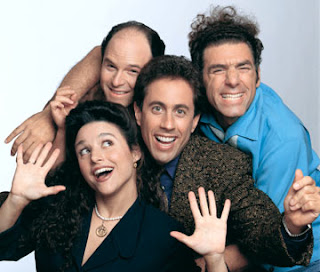
Larry David and Jerry Seinfeld's genius decision to craft a sitcom that ignored the touchy-feely for the everyday hilarious created a mainstream comedy hit that NBC continues to search for today. The series is so rife with quotable lines, pop cultural creations, and memorable secondary characters that it would require a volume to chart its social significance. Though the series killed the careers of several of its stars (with the notable exception of David, whose "Curb Your Enthusiasm" was too off-the-wall to include in this list), its legacy remains untouchable to this day, and its prominent position in syndication during primetime on several networks attests to its staying power.
Did I forget your favorite? Let me know!
Recently finishing a whirlwind viewing of the first six seasons of the currently-popular "How I Met Your Mother," I've been thinking a lot about what sitcoms have picked my spirits up over the last several years. Here's a list of my favorites.
(A note: There are myriad definitions for what constitute a sitcom. For the purposes of this post, I'm not limiting my selections to the traditional sound-stage set, live audience, laugh track sitcom, though I know for purists out there this constitutes sacrilege. All complaints can be sent in writing to my non-existent secretary.)
10. How I Met Your Mother (2005-present)
Favorite Episode: "Slapsgiving"
Using an ingenious constant flashback device, How I Met Your Mother features both humorous nods to long-time viewers (the Slap Bet, the Goat, "Haaaaaaave ya met Ted?") interested in the overall plot of the show and great one-off episodes that explore the very nature of story-telling and embellishing. A smart comedy in an era where they appear few and far between.
9. The Office (2005-present)
Favorite Episode: "The Return"
Another series that has recently come under fire for declining quality (illustrating the woefully short lifespan for great sitcoms), the American "Office" program hit its stride with the introduction of Andy Bernard (Ed Helms) and other secondary characters in its third season, as the central relationship between Jim and Pam began to attain more significance and drama. Featuring some of this generation's finest comedic character actors, "The Office" proves that a great sitcom is sometimes merely the sum of its parts.
8. Friends (1994-2004)
Favorite Episode: "The One With All the Thanksgivings"
Sure, it was rather Anglo-centric, and in retrospect is probably viewed with a greater amount of nostalgia by today's audiences than for its actual quality, but "Friends" was huge for several key components that are necessary in any successful and classic sitcom: on-screen chemistry, excellent writing, and compelling characters that both make you laugh and invite you to share in the ups and downs of their daily lives.
7. The Wonder Years (1988-93)
Favorite Episode: "Good-bye"
Twenty years before "Superbad," Carol Black and Neal Marlens brought us the closest approximation of being a teenager allowable on network television through the popular sitcom convention of the flashback, currently used by the aforementioned "How I Met Your Mother." This selection, of course, stresses the definition of what a sitcom can be, with The Wonder Years tackling serious issues like Vietnam, death (in the very first episode, no less!), and the painful process of growing up on an almost weekly basis. But tucked away are brilliant comedic moments narrated to perfection by the incomparable Daniel Stern. And, like most sitcoms, the show killed the career of every actor involved (Paul's rumored turn as Marilyn Manson notwithstanding).
6. The Cosby Show (1984-92)
Favorite Episode: "Pilot"
Even ignoring the social significance of The Cosby Show, bringing the middle-class African-American family to the forefront of American mainstream culture in a way shows like "The Jeffersons" and "Sanford and Son" could never do (and paving the way for the tremendous "Family Matters" which only barely missed out on this list), The Cosby Show rallied around its tremendously popular eponymous star and created one of the finest examples of American family comedy to date. Continuously emulated but never equaled, "Cosby" continues its position of privilege in the annals of American television history to this day, and still holds up well over twenty years later in syndication on several major networks.
5. Scrubs (2001-10 [supposedly, though we all know it ended in 2009])
Favorite Episode: "My Screw Up"
"Spin City" was an excellent first creative project for Bill Lawrence, but he hit something special with "Scrubs" that defied genre expectations and gave the hospital setting a swift, irreverent kick in the pants. Solid principal characters, surrounded by a constantly-growing and developed ensemble cast, allowed Scrubs to hit a high mark in its third season in terms of both dramatic story-telling and comedy.
4. M*A*S*H* (1972-83)
Favorite Episode: "Abyssinia, Henry"
Arguably, M*A*S*H became a better show once it cast off the traditional sitcom elements that characterized the show during its first several seasons: canned laughter in the operating room, the departure of Larry Lanville's Frank Burns as the stiff CO, and the incorporation of more actual Korean War surgeon stories into the plotline of the show, granting the series additional weight. However, the constant levity brought by the larger-than-life Hawkeye and the strong ensemble cast keep M*A*S*H in the discussion for not only greatest sitcom, but greatest television program ever to this day.
3. Cheers (1982-93)
Favorite Episode: "The Last Angry Mailman"
Like M*A*S*H, Cheers' mainstream popularity afforded the program an unusually long run for a sitcom and a number of spin-off projects (including the wildly hilarious in its own right "Frasier"). Cheers remains a mainstay in syndication to this day thanks to the social issues it confronted boldly in the 1980s, and the popularity of its strong ensemble cast rounded out by Norm Peterson and Cliff Clavin-guys you'd want to have a drink with in real life. Its close-knit charm in a big city provides the escapism needed in any endearing sitcom.
2. Arrested Development (2003-6)
Favorite Episode: "The Immaculate Election"
It is inexplicable that FOX has given so many horrible shows a chance over the years, but barely showed any support to the finest program to yet air on their network (yeah, you heard that right "Simpsons"). Arrested Development, like many other shows on this list, takes the conventions of sitcoms and irreverently turns them around, poking fun at the genre, audience, and show itself all to the delight of the audience. Special props for getting sitcom legend Ron Howard to provide the skeptical narration that ties the show together, and for perhaps one of the funniest group of secondary characters to appear on the same screen. It's great to see Archer on FX carry on the dysfunctional family tradition from "Arrested Development," and to see all of the actors move on (more or less) to continued work on some inspired comedic projects. But now, let's get them all back together for that promised movie, damnit!
1. Seinfeld (1989-98)
Favorite Episode: "The Caddy"

Larry David and Jerry Seinfeld's genius decision to craft a sitcom that ignored the touchy-feely for the everyday hilarious created a mainstream comedy hit that NBC continues to search for today. The series is so rife with quotable lines, pop cultural creations, and memorable secondary characters that it would require a volume to chart its social significance. Though the series killed the careers of several of its stars (with the notable exception of David, whose "Curb Your Enthusiasm" was too off-the-wall to include in this list), its legacy remains untouchable to this day, and its prominent position in syndication during primetime on several networks attests to its staying power.
Did I forget your favorite? Let me know!
Subscribe to:
Comments (Atom)